 +86-151 6276 6160
 بيع002@hxdrobots.com
 English
 Español
 Pусский
 Français


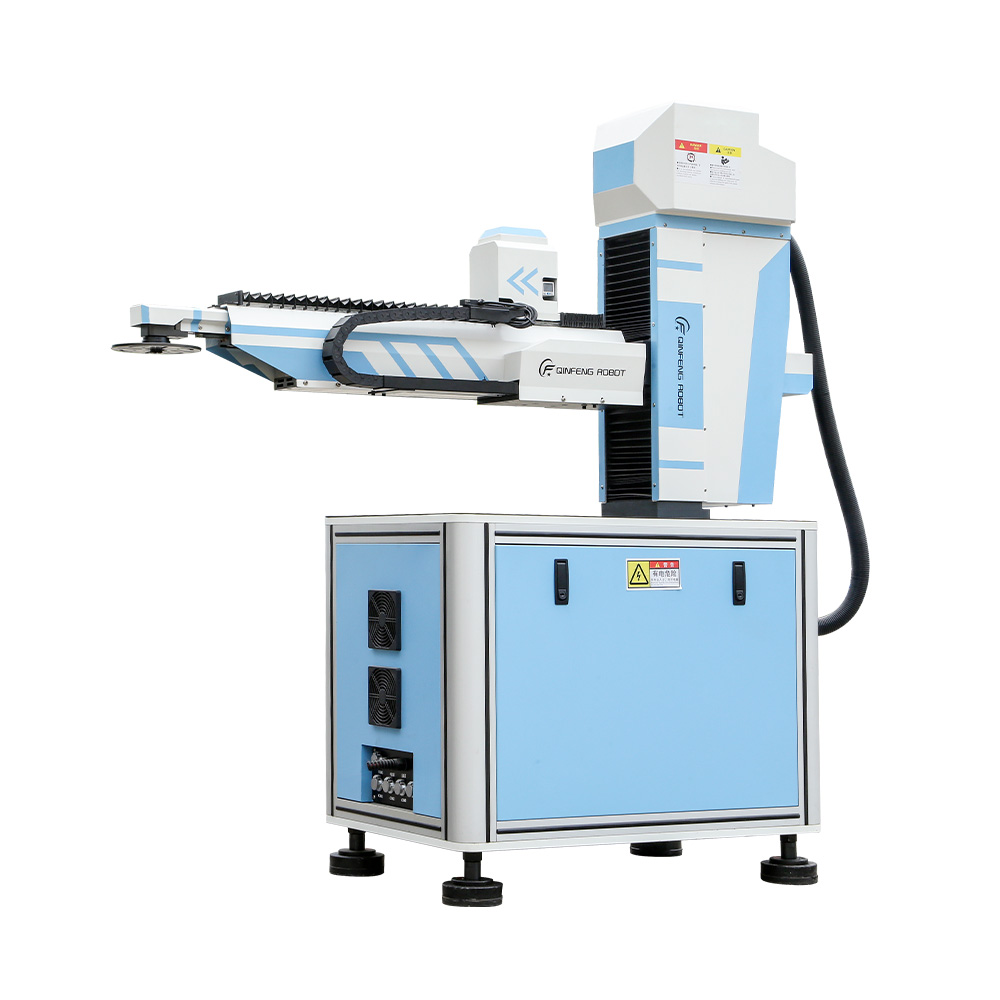
The Accuracy Guarantee Principle of a Stamping robot
In modern manufacturing, Stamping robots are widely used for sheet metal forming, blanking, bending, and related operations. These robots must work with high precision and stability, because even small deviations in position, force, or timing can lead to defective products, tool damage, or serious safety risks. The “accuracy guarantee principle” of a Stamping robot refers to the key design concepts, control methods, and operational practices that ensure the robot consistently meets the required accuracy in its working environment.
**1. Sources of Inaccuracy in Stamping robots**
Before explaining how accuracy is guaranteed, it is important to understand the main sources of inaccuracy in a Stamping robot system:
1. **Mechanical errors**
- Assembly tolerances of arms, joints, and end-effectors
- Backlash in gears and reducers
- Elastic deformation of robot links and grippers under heavy loads
- Wear and tear over time in bearings, guides, and joints
2. **Control and sensor errors**
- Limited resolution of encoders and position sensors
- Nonlinearities in servo motors and drives
- Delay in control loops and communication
- Temperature drift affecting sensor readings
3. **Process and environmental factors**
- Vibration from nearby presses and machines
- Thermal expansion of tools, fixtures, and robot structure
- Variation of workpiece position, thickness, or hardness
- Contamination such as oil, dust, or metal particles on sensors and surfaces
The accuracy guarantee principle provides a systematic approach to counter these factors through design, calibration, control, and maintenance.
**2. Structural and Mechanical Design Principles**
The first level of accuracy assurance lies in the mechanical design of the Stamping robot:
1. **High-stiffness structure**
The robot arm and base should be designed with high stiffness to minimize deflection under load. Finite Element Analysis (FEA) is usually used to optimize cross-sections, materials, and weight distribution. A stiffer structure translates directly into better positioning and repeatability.
2. **Precision transmission systems**
High-precision reducers, low-backlash gears, and accurate ball screws or linear actuators are essential. Preloaded bearings and guideways reduce clearances and improve stability. The quality of these components has a major impact on robot accuracy and repeatability.
3. **Optimized end-effector design**
The gripper or tooling attached to the robot must be rigid, lightweight, and precisely manufactured. Its mounting interface must ensure accurate and repeatable positioning relative to the robot flange. Quick-change systems often include mechanical or kinematic locating features to maintain accuracy during tool changes.
4. **Dynamic performance design**
The robot must be able to move quickly yet maintain accuracy. Proper selection of motor power, gear ratios, and inertia matching helps achieve high dynamic response while avoiding overshoot or vibration. Damping measures may be added to limit resonance caused by stamping shocks.
**3. Calibration and Kinematic Accuracy**
Even with a precision mechanical structure, calibration is necessary to guarantee absolute accuracy:
1. **Kinematic model calibration**
The robot controller uses a kinematic model based on link lengths, joint offsets, and other geometric parameters. Factory or on-site calibration adjusts these parameters by comparing measured positions (via external measurement devices such as laser trackers or 3D cameras) with commanded positions. This greatly reduces systematic geometric errors.
2. **Tool Center Point (TCP) calibration**
The TCP defines the exact position and orientation of the working point (for example, the gripping center or stamping interface) relative to the robot flange. Accurate TCP calibration ensures that programmed paths and process positions correspond closely to reality.
3. **Base and workpiece coordinate calibration**
The relative position between the robot base, stamping press, and workpiece fixtures must be accurately determined. By calibrating reference points on the die or worktable, the robot can correctly transform coordinates from its internal system to the actual production environment.
4. **Offline programming verification**
When using offline programming, CAD-based simulation and collision checking help verify both reachability and positional accuracy before actual production. Post-calibration models are used in simulation to reduce differences between virtual and real motions.
**4. Control System and Compensation Techniques**
The control system is the core of the accuracy guarantee principle. It includes both hardware (controllers, drives, sensors) and software (algorithms, compensation functions):
1. **High-resolution feedback**
Using high-resolution encoders for each joint improves the robot’s ability to detect small movement changes. In some cases, secondary encoders or linear scales are installed on critical axes to measure actual position directly, bypassing transmission errors.
2. **Advanced servo control algorithms**
Closed-loop servo systems with PID or more advanced control algorithms (such as model-based control, feedforward control, and adaptive control) improve response and reduce tracking errors. Anti-vibration and jerk-limiting algorithms help maintain stability when the stamping press generates impact loads.
3. **Error mapping and compensation**
Systematic errors, such as joint angle nonlinearities or link deflections, can be mapped and stored in the controller. During operation, the control system automatically applies compensation values based on robot configuration and load, improving absolute positioning accuracy.
4. **Temperature and load compensation**
Since thermal expansion and varying loads can affect position, some advanced systems monitor temperature and torque of joints. The controller then compensates for expected deflection or expansion, maintaining accuracy over a range of operating conditions.
5. **Real-time monitoring and correction**
Vision systems, laser sensors, or proximity sensors can provide real-time feedback about the workpiece and tool position. If a misalignment is detected, the robot can adjust its trajectory online before performing a stamping action.
**5. Process Integration and Coordination with the Press**
Accuracy of a stamping robot is not independent of the stamping process itself. Proper integration and synchronization with the stamping press is essential:
1. **Synchronization with press cycles**
Communication between robot controller and press controller ensures that the robot moves at the correct time relative to press strokes. Accurate timing prevents collision and ensures that the workpiece is correctly placed when the die closes.
2. **Accurate positioning in dies and fixtures**
The design of locating pins, clamps, and die features must match the robot’s accuracy capability. If the fixtures are loose or imprecise, overall system accuracy will degrade even if the robot itself is accurate.
3. **Force and contact control**
When inserting workpieces into dies or removing stamped parts, the robot may need to control contact force. Force sensors and compliant mechanisms help avoid excessive force that could distort positioning or damage parts.
**6. Quality Control, Maintenance, and Human Factors**
Long-term accuracy depends not only on design and control, but also on operational discipline:
1. **Regular inspection and recalibration**
Periodic checking of robot accuracy using reference gauges, measurement systems, or test routines helps detect drift. When necessary, recalibration of TCP, base frames, or kinematic parameters is performed.
2. **Preventive maintenance**
Lubrication, tightening of mechanical joints, replacement of worn components, and cleaning of sensors and guideways all contribute to maintaining accuracy. Maintenance schedules should be based on both operating hours and process severity.
3. **Process capability monitoring**
Statistical process control (SPC) methods can analyze stamped part dimensions over time. Trends in measurement data may indicate gradual loss of robot or system accuracy, prompting timely intervention.
4. **Operator training**
Properly trained operators and engineers are essential. Incorrect teaching of points, improper fixture setup, or careless tool changes can quickly negate the technical accuracy built into the robot system.
**7. Safety and Reliability Considerations**
A stamping robot must guarantee accuracy not only for product quality, but also for safety:
1. **Safe zones and interlocks**
Safety systems define safe working envelopes and monitor robot position. If actual position deviates from expected paths, or if a fault occurs, the system will stop operation to avoid accidents.
2. **Redundancy and diagnostics**
Self-diagnosis functions detect sensor failures, communication errors, or control anomalies that could compromise accuracy. Redundant critical sensors may be used in high-risk applications.
3. **Robustness to disturbances**
The stamping environment can be harsh. The accuracy guarantee principle includes measures to ensure that the robot remains accurate despite vibration, shock, temperature changes, and contamination, thereby improving overall reliability.
**Conclusion**
The accuracy guarantee principle of a stamping robot is a comprehensive concept that combines mechanical design, calibration, advanced control, process integration, and disciplined operation. By addressing potential errors at each level—structure, sensors, algorithms, fixtures, and human operation—a stamping robot can attain and maintain the high accuracy required for modern automated stamping lines. This not only improves product quality and production efficiency, but also enhances safety and extends the service life of equipment in demanding industrial environments.
يستخدم هذا الموقع ملفات تعريف الارتباط لضمان حصولك على أفضل تجربة على موقعنا.



 هاتف
تعليق
(0)