 +86-151 6276 6160
 بيع002@hxdrobots.com
 English
 Español
 Pусский
 Français

Of course — here is a **1000-word English article** on **“Pneumatic Working Principle of Stamping robot”**:
---
Pneumatic Working Principle of Stamping robot
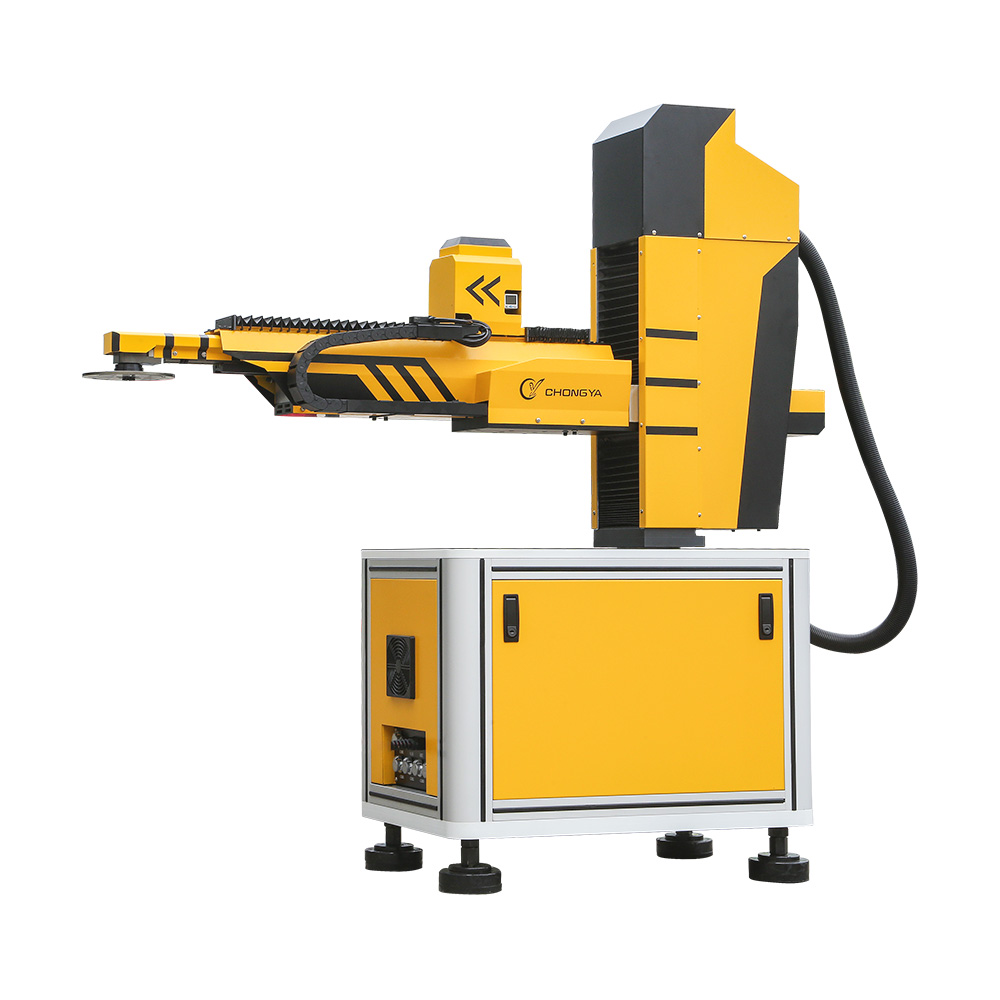
A Stamping robot is an industrial robot widely used in manufacturing processes such as metal forming, blank handling, loading and unloading, and press automation. In many stamping production lines, pneumatic systems play an important role in helping the robot achieve fast, stable, and accurate motion. Pneumatics uses compressed air as the working medium to transmit power and control movement. Compared with hydraulic systems, pneumatic systems are cleaner, simpler, and more suitable for high-speed repetitive operations. Understanding the pneumatic working principle of a Stamping robot is essential for improving production efficiency, ensuring safety, and maintaining equipment performance.
1. Basic Concept of Pneumatics in Stamping robots
Pneumatics refers to the use of compressed air to generate mechanical motion. In a Stamping robot, pneumatic components are often used in the gripper, arm locking mechanism, braking unit, suction device, and auxiliary positioning devices. The main function of the pneumatic system is to convert the energy of compressed air into linear or rotational motion so that the robot can pick up, hold, move, and release stamped parts accurately.
In a stamping line, the robot usually needs to handle metal sheets or stamped workpieces quickly and repeatedly. Pneumatic devices are ideal for this task because they can respond rapidly and provide sufficient force for gripping and releasing objects. Their structure is relatively simple, which makes maintenance easier and reduces operating costs.
2. Main Components of the Pneumatic System
The pneumatic working principle of a Stamping robot depends on several key components:
2.1 Air Compressor
The air compressor is the source of compressed air. It takes in atmospheric air and compresses it to a higher pressure. This compressed air is then stored in an air tank and distributed to different pneumatic devices in the robot system.
2.2 Air Treatment Unit
Before compressed air enters the robot’s pneumatic devices, it must be cleaned and prepared. The air treatment unit usually includes a filter, pressure regulator, and lubricator. The filter removes dust and moisture, the regulator maintains stable pressure, and the lubricator adds oil mist if required to reduce friction in moving parts.
2.3 Directional Control Valve
The directional control valve is one of the most important parts of the pneumatic circuit. It controls the direction of airflow into and out of the cylinder or actuator. By changing the valve position, the robot can extend or retract a cylinder, open or close a gripper, or switch between different working states.
2.4 Pneumatic Cylinder or Actuator
The pneumatic cylinder converts air pressure into linear motion. In a Stamping robot, cylinders are commonly used to drive grippers, lifting arms, or clamping devices. Some robots may also use rotary pneumatic actuators for turning or adjusting the angle of a workpiece.
2.5 Sensors and Control Unit
Sensors detect the position of the robot and the state of pneumatic components. The control unit, often based on PLC or robot controller software, receives sensor signals and sends commands to solenoid valves. This ensures that the pneumatic motion is coordinated with the stamping machine cycle.
3. Working Principle
The working principle of a Pneumatic stamping robot can be explained in a simple sequence.
First, the air compressor supplies compressed air to the air tank. After passing through the air treatment unit, the clean and regulated air is directed to the pneumatic control valves. When the robot needs to grasp a stamped part, the controller sends an electrical signal to open the corresponding solenoid valve. The valve allows compressed air to flow into the cylinder chamber.
As the air pressure increases inside the cylinder, the piston moves forward. This movement is transmitted to the gripper or end-effector, causing it to close and hold the workpiece. When the robot arm moves to the next position, the pneumatic system maintains the gripping force so that the part does not slip.
After the robot reaches the target location, the controller sends another signal to reverse the valve. The air is then released from the cylinder chamber, and the piston returns to its original position under spring force or reverse air pressure. As a result, the gripper opens and releases the workpiece. This entire process happens very quickly, allowing the robot to match the high cycle speed of stamping equipment.
4. Advantages of Pneumatic Operation
Pneumatic systems offer several advantages in Stamping robots. First, they are fast. Compressed air can move actuators rapidly, which is important for high-speed stamping production. Second, they are clean. Since air is the working medium, there is no risk of oil leakage like in hydraulic systems. This makes pneumatics suitable for factory environments where cleanliness and product quality matter.
Third, pneumatic systems are relatively inexpensive and easy to maintain. The components are simple, and most faults can be diagnosed quickly. Fourth, they are safe in many applications because compressed air is less hazardous than high-pressure liquid. Pneumatic systems also provide good repeatability, which is essential for robotic handling tasks.
5. Limitations of Pneumatics
Although pneumatics has many advantages, it also has some limitations. One major limitation is that air is compressible, which makes precise position control more difficult than with electric or hydraulic systems. This means pneumatic robots are usually better for simple on-off actions rather than complex motion paths.
Another limitation is that pneumatic force depends on air pressure and cylinder size. If the load is too heavy, the system may not provide enough gripping force. In addition, compressed air systems can waste energy because air leaks or excessive pressure can reduce efficiency. Therefore, good maintenance and proper design are necessary to ensure stable operation.
6. Applications in Stamping Production Lines
In modern stamping production lines, pneumatic robots are used for many tasks. They can transfer metal sheets from one press to another, remove finished parts from molds, stack products, or assist in feeding materials into stamping machines. Pneumatic grippers are especially useful when handling thin sheets, small components, or parts with surfaces that must not be damaged.
The robot often works in synchronization with the press. When the press opens, the pneumatic robot enters the working zone, picks up the part, and exits before the next stamping cycle begins. This cooperation improves productivity and reduces the need for manual labor.
7. Conclusion
The pneumatic working principle of a Stamping robot is based on the use of compressed air to generate motion and control gripping actions. Through the cooperation of compressors, valves, cylinders, sensors, and control systems, the robot can perform fast and repeated handling tasks in a stamping line. Pneumatic systems provide speed, simplicity, cleanliness, and reliability, making them an important part of industrial automation. Although they have some limitations in precision and load capacity, they remain highly effective for many stamping applications. As manufacturing continues to develop, the integration of pneumatics with modern control technologies will make stamping robots even more efficient and intelligent.
---
If you want, I can also help you turn this into:
1. **a more academic essay**,
2. **a PowerPoint-style outline**, or
3. **a Chinese-English bilingual version**.
يستخدم هذا الموقع ملفات تعريف الارتباط لضمان حصولك على أفضل تجربة على موقعنا.



 هاتف
تعليق
(0)